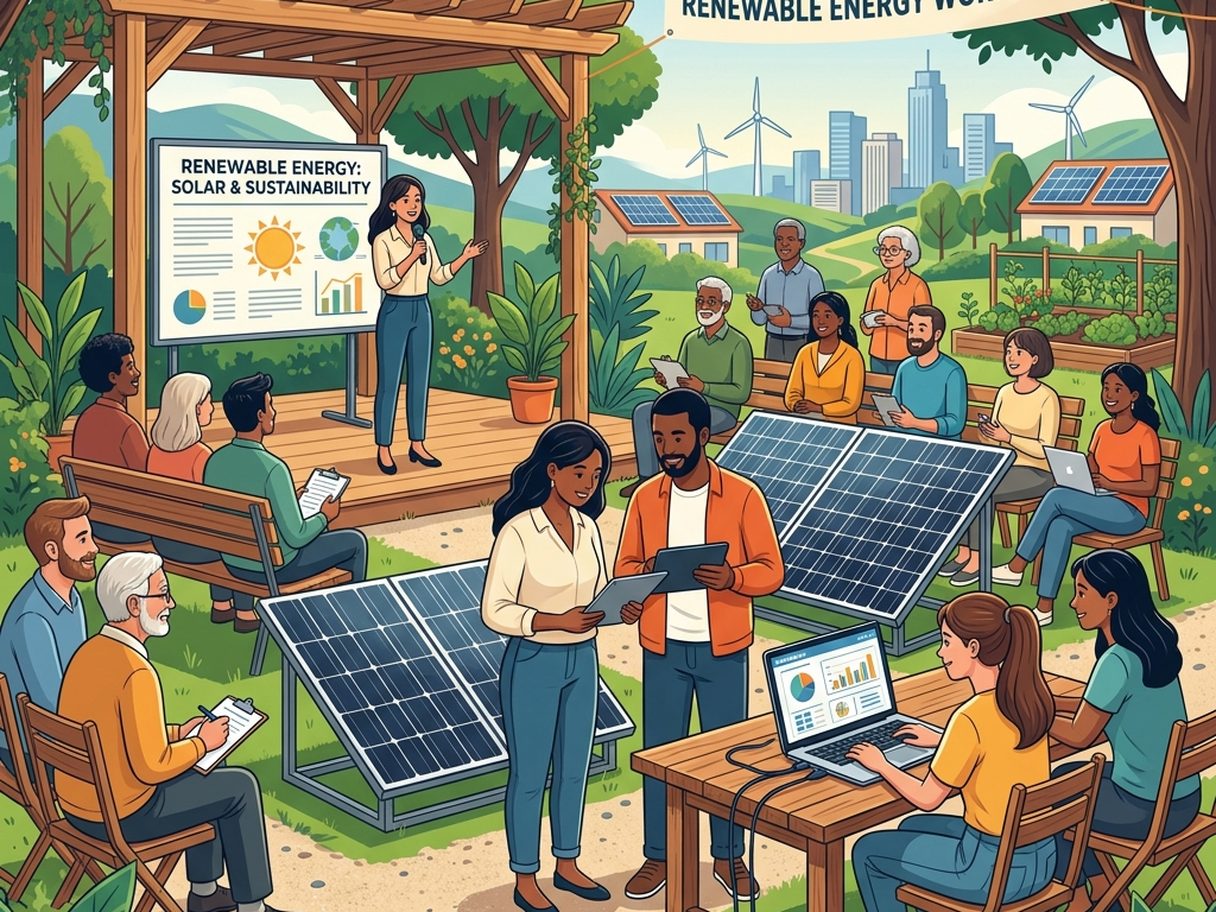
Technological sovereignty is not earned by sitting through slide decks—it is built with a soldering iron, a multimeter, and wire strippers in hand. Instead of passive theoretical lectures, we organize intensive, hands-on maker laboratories where every participant learns how to dimension their own standalone solar array, assemble custom LiFePO4 battery packs safely, and configure edge computing nodes that run completely independent of the commercial electrical grid and internet infrastructure.
Hands-On Hardware Hacking Labs
Our laboratory workshops take place on fully equipped maker benches featuring professional bench instruments: - Diagnostic & Measurement Equipment: Participants work with digital true-RMS multimeters, dual-channel digital storage oscilloscopes (Rigol DS1054Z), current-limiting CC/CV bench power supplies, and radiometric thermal imaging cameras (InfiRay P2 Pro) to identify trace hotspots, parasitic resistances, and thermal bottlenecks on custom PCBs. - Real-World PV Benchmarking: Measuring monocrystalline, polycrystalline, and flexible ETFE solar panels under direct sunlight, overcast skies, and deliberate partial shading angles to trace empirical Current-Voltage ($I-V$) and Power-Voltage ($P-V$) curves. - MPPT vs PWM in Practice: Live bench demonstrations illustrating why conventional PWM regulators forfeit up to 30% of harvestable solar energy (by dragging the PV panel down to the battery voltage), and dissecting how true Maximum Power Point Tracking (MPPT) uses synchronous buck topology to dynamically harvest peak wattage. - Ultra-Low Quiescent Current Conversion: Selecting and tuning DC-DC buck regulators with quiescent current ($I_q$) below $15\mu\text{A}$, ensuring microcontrollers and IoT sensors can idle for months without draining backup storage.
Safe DIY LiFePO4 Battery Pack Assembly
Lithium storage is the critical foundation of off-grid engineering, demanding strict chemical understanding and meticulous safety protocols: - LiFePO4 Chemistry & Intrinsic Safety: We build exclusively with Lithium Iron Phosphate ($\text{LiFePO}_4$). Thanks to its robust olivine crystal structure with strong covalent $\text{P-O}$ bonds, LiFePO4 does not release oxygen upon overcharging and exhibits a thermal runaway threshold exceeding $270^\circ\text{C}$ (contrasted with standard NMC/LCO Li-ion cells where violent runaway can trigger at just $150^\circ\text{C}$). Each cell operates at a nominal 3.2V, with a strict operating window from 2.50V (low-voltage cutoff) to 3.65V (high-voltage charge limit) and a resting float voltage of 3.35V–3.40V, delivering 3,000 to 5,000 deep cycles at 80% DoD. - Cell Sorting & 4-Wire Kelvin AC IR Testing: Every incoming cell (cylindrical 32700s or prismatic EVE 105Ah/280Ah units) is matched using a 1 kHz 4-wire AC milliohm meter (YR1035+) to ensure internal resistance variance remains within 2% across the pack. - Precision Capacitive Spot Welding: Fabricating battery packs using dual-pulse capacitive discharge spot welders (kWeld) generating 800A–1200A pulses for 10–20 ms. We use verified pure nickel strips (0.15 mm – 0.20 mm thickness, validated by spark grinding and saline corrosion tests to exclude counterfeit nickel-plated steel). For larger prismatic cells, we demonstrate solderless modular compression holders with solid copper busbars.
BMS Architectures & Active Balancing
An unmanaged lithium battery is an unacceptable hazard. The lab teaches rigorous integration of Battery Management Systems (BMS): - 4S (12.8V) and 8S (25.6V) Topologies: Wiring and configuring smart BMS boards (Daly, JBD, Ant-BMS) equipped with digital telemetry (UART/Bluetooth/RS485 Modbus). - Active vs Passive Balancing: Installing inductive and flying-capacitor active balancers capable of transferring 1A–2A of charge between adjacent cells without generating destructive heat, completely superseding inefficient 35mA passive resistive bleeders. - Low-Temperature Charge Invalidation: Calibrating NTC thermistor cutoffs to enforce a strict 0°C charging lockout. Charging a LiFePO4 cell below freezing causes permanent metallic lithium plating on the anode, resulting in micro-dendrite growth and catastrophic internal shorts. The BMS firmware is configured to allow cold discharging while strictly blocking charging until the pack reaches safe ambient temperatures.
Building Resilient Off-Grid Computing Nodes
We connect power electronics and computational hardware into an autonomous field node: - Low-Power SBC Integration: Interfacing PV panels, MPPT controllers, and LiFePO4 packs with efficient single-board computers (Raspberry Pi Zero 2W, Orange Pi, ESP32). - Self-Hosted Offline Services: Deploying zero-internet server stacks: local captive-portal Wi-Fi, Kiwix offline Wikipedia and medical libraries, SQLite sensor dataloggers, and Meshtastic LoRa repeaters. - Power Budgets & Deep Sleep: Implementing RTC-based hardware watchdog timers and OS power governors allowing edge nodes to enter timed hibernation and survive multi-day winter overcast stretches.
Freely Accessible Open Educational Materials
All Slobodna Energija workshop curriculum is shared freely without intellectual property barriers: - Comprehensive lab manuals, wiring schematics, and slide-free workshop outlines released under Creative Commons CC-BY-SA 4.0. - Complete circuit schematics and PCB Gerber files developed in KiCad, ready for rapid fabrication. - Open Bills of Materials (BOM) with transparent supplier part numbers and 3D-printable CAD files (STL/STEP) for modular battery trays and sensor brackets. Any student, teacher, or hackerspace collective is encouraged to take these materials and replicate hands-on workshops in their own community.
Discussion
Discussion is not open yet.